History is only predictable from afar. Up close, everything is confusing.
— Quote from Brazil: A Biography, by Lilia M. Schwartz and Heloisa M. Starling
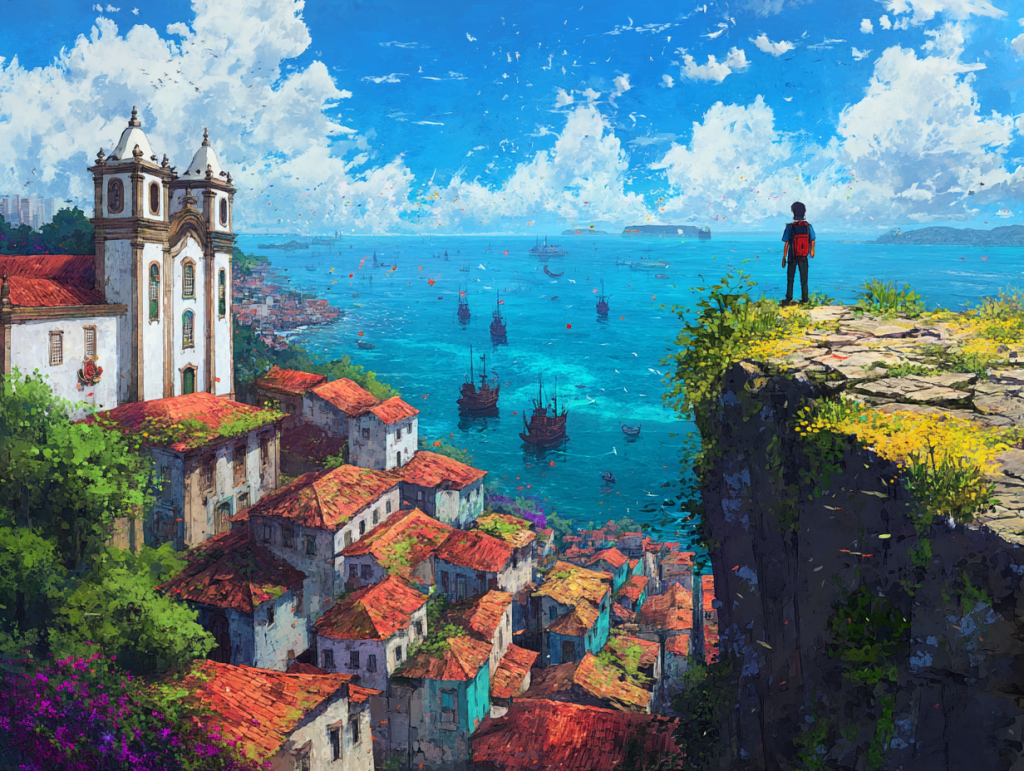
From the vast land of Pampas at Rio Grande do Sul to the shield mountain of Roraima, from the dense jungle on the Acre state to the sunset of the Fernando de Noronha, Pernambuco, this tropical continent which is called Brazil never lack exotic elements: sun, flowers, birds, Palmeiras, Amazon river, Pantanal, Foz Iguaçu, indigenous myth, multiethnic group of individuals, elegant curve of the churches, sad story of injustice, people of the nation with smiles albeit suffering etc. Brazil is not just simply a country; for some people, it is just a place to accumulate fortune and goes back; for many people, it is an unwillingness of relocation or reconstruction; and for the majority of people today in this land, it is their home, whether they like it or not.
Brazil’s history, from the arrival of the Portuguese on 22 April 1500 to the present, is a relatively short period compared to the entirety of human civilization. But it is impossible to neglect the richness of the story. In such a manner, this text serves as a review of the book Brasil, uma biografia. Of course, I cannot discuss every detail of the book’s content. The most productive way is to choose an interesting perspective to discuss Brazilian history.
As I mentioned in the first paragraph, we describe this country as a continent, a vast landmass encompassing all the lands in the world. How was this giant land formed? There are many more intriguing questions: How can we maintain this giant land as one? Also, during these 500 years, was this land unified without rebellion trying to divide it? A seemingly obvious answer of “yes” or “no” is not the purpose of this review: in fact, an attempt will be made to understand the flow of power based on the region and their disputes.
Brasil’s Name, Sugar Cane Economy and Slavery
It is incredible how the world used to be divided into two countries: Spain and Portugal, but this is a reality in the Tordesilhas treaty: A line that divides the world in half, perfectly crossing the Brazilian territory, with the east part of the line belonging to Portugal and the west side belonging to Spain. That means: Brazil shouldn’t be as big as it is today.
However, for Portugal at that time, it was relatively acceptable, as the focus of the empire was trade with India. So although on April 22, 1500, Brazil was already discovered by Pedro Álvares Cabral, it is in a peripheral situation. The name of this new land also has multiple names: Land of the Holy Cross (Terra da Santa Cruz), Ilha de Vera Cruz (Island of the True Cross), and Terra dos Papagaios (Parrots’ Land). In the final economic exploration, the reason behind every other name wins out: Brasil (cor da brasa, flame-colored), or Pau-Brasil, or Brasilwood, a wood that can extract rich, red pigments, signifies an inevitable destiny for this land: exploration.
Of course, such a vast tropical land would be perfect for planting spices. That was the Portuguese plan, too: sugar cane, a plant from Papua New Guinea that highly concentrates sugar, was first introduced in the Ilha de Madeira, then in today’s São Tomé and Príncipe, and subsequently introduced to this land of Brazil. Thus formed the first concrete economic sector: sugar cane economy.
To plant the sugar cane, it is necessary to deforest, so the knowledge of Brazil began with dots, then connecting lines, and then into areas, which is called internalization. Land was divided into different parts by the method of sesmarias (land grants granted by the Portuguese Crown to colonists for the development and settlement of Brazilian territory). More Portuguese are moving to their continent, with a major concentration in the northeast region of Brazil, and Salvador is the first capital of this land.
However, Portuguese is not alone: this land has long been home to the indigenous people for thousands of years. Although there is a scarcity of workforce in Brazil, it is difficult to transform indigenous people into slaves, due to their “disobedient” character. That is why the idea of bringing black people as slaves into Brazil became a reality. During 500 years, more than 7/10 of Brazil’s history was marked by slavery. Bahia, a large northeastern state of Brazil, has the largest quantity of black people outside of Africa in one state. The resistance of the slaves is also remarkable to mention: they broke the rules indirectly, they fled, and they formed a colony, which in Brazil is known as a Quilombo. The most famous, Quilombo de Palmares, resisted the regime for nearly a century.
At last, it is necessary to mention the colonization of non-Portuguese: beyond the famous French invasions in the region of today’s Rio de Janeiro and a period of the Ibérica Union(Portuguese and Spanish were as one, the invasion with the most impact was, of course, the Dutch invasion of today’s Pernambuco. Unlike the sole plan of exploration, the Dutch carefully administered the region, constructed roads, buildings, and incentives for artistic and intellectual works. Of course, in the end, Pernambuco was retaken by the Portuguese, but the theory remains that Brazil would be stronger if the Dutch had colonized it. And, of course, this invasion defined the region of Pernambuco as one of the most rebellious against the central government.
Gold Economy and Rebellions
The concentration of total production in the Northeastern region did not prevail significantly. With the discovery of gold in the region of Minas Gerais, the colony’s primary function swiftly shifted to gold mining. Finding silver and gold was the dream of every colonizer. That is why the group of bandeirantes(flag-carriers, settlers in colonial Brazil who participated in expeditions to expand the colony’s borders and subjugate indigenous peoples during the early modern period) exists. In fact, the Portuguese-Brazilian expansion beyond the line of Tordesillas was made possible with the help of these bandeirantes. And of course, with a much more internalization of the colony’s territory, the most important thing is to find economies to maintain this vast territory; that is when the Gold economy naturally surges. The gold economy, with significantly more margin than the sugarcane economy, has since then defined the concentration of financial and political power in the southeastern region of Brazil. In 1763, the Portuguese Brazilian colony changed its capital from Salvador to Rio de Janeiro, as it is the most important port for gold transportation.
However, even Brazil’s gold economy cannot save the fate of Portugal’s global empire. Although the reform of the Marquis of Pombal (Marquês de Pombal) did not halt the decline of the Portuguese, for historians researching Brazil, the rebellions preceding the arrival of the Portuguese royal family are the most significant topic during this period. The Brazilian was increasingly aware of the uniqueness of Brazil within the empire, and this awareness, combined with the influence of the Enlightenment, led to the Minas Gerais Conspiracy. Inspired by the independence of the thirteen colonies in North America, their plan was to liberate the captaincy from Portuguese rule and establish an independent government, with the proclamation of a republic. It is worth noting that their idea predated the French Revolution.

Rebellion, in fact, represents a dissatisfaction with the current regime and involves acts of opposition against the government. Throughout Brazilian history, rebellion has been an enduring theme, whether led by slaves, local people, the local elite, or in the pursuit of Brazil’s independence, as exemplified by D. Pedro, the prince of Portugal’s global empire. The justification for insurrection could be numerous, including political, economic, regional, religious, slavery-related demands, as well as high taxes. An excessive quantity of insurrection, independently in the form of a colony, an empire, or a republic, indicates that the power of the central government is constantly challenged. Especially, we can clearly see a pattern: the bureaucratic part ignores the people’s requests, disrespects them, or the bureaucratic part itself is the problem, and everything should be resolved violently. In Brazil, the institutional order is just on paper, not a sacred law to be followed. Circumventing the rule, or even challenging it, is an extension of the Jeitinho Brasileiro (Brazilian Little Way), as Brazilians often do not trust their bureaucracy, which is somewhat justified given the central government’s traditional association with low efficiency, corruption, discrimination, and injustice.
Royal Family and Brazil’s Independence
If one were to choose the foreigner who has had the most significant influence on Brazil’s history, it would be Napoleon Bonaparte, and the reason is straightforward: his Napoleonic Wars compelled the Portuguese royal family to leave their metropolis and relocate to Brazil, which had numerous consequences.
But from the perspective of this text, the consequence is geographical: a European monarch, for the first time, immigrated to their colony and created a new central empire system inside the periphery. In fact, why Brazil? Why not other colonies or some other countries? In fact, Portugal already has a nice relationship with the British; it is an interesting option to create an asylum government in the British Empire. However, in the end, the monarchy, recognizing the impossibility of defeating Napoleon Bonaparte, as demonstrated by the Spanish’s failure, decided on the best course of action: neither fighting nor surrendering, but rather believing that there was hope for their colony.
In fact, the failure of resistance by the Spanish and the escape of the Portuguese ultimately determined the different destinies of their colonies, respectively. As Spain lost its old monarchy and Napoleon’s brother came to power, Spanish America, already dissatisfied with its old regime, seized this opportunity to begin its process of independence. Spain lost its old monarchy and its colonies as well. On the contrary, the Portuguese Empire was more astute: they brought their government to Portuguese America, allowing Portugal to control the most important colony of its empire and subsequently maintain the original structure of the empire. In fact, if you were to attend school today to learn about Brazil’s history, there are three distinct periods that the teacher would likely cover separately: the colonial period before the arrival of the royal family, the reign and regency period of D. Pedro, and the old republic period. Between the first two periods lies the existence of the Portuguese monarchy. We cannot say that there was no conflict during these long years, as evidenced by the Pernambucana Revolution, which occurred during the monarchy’s existence. However, compared to the three periods we discussed earlier, in this period, the Brazilian rebellion is not in a situation where the central government cannot handle it.
Separately, the Pernambucana Revolution is linked to the socioeconomic crisis that the Northeast had been experiencing for nearly a century, largely due to the devaluation of Brazil’s sugar and cotton trade in the foreign market. In addition, the presence of the Portuguese royal family in Brazil increased the cost of living due to taxation, which caused unrest among the people of Pernambuco. The movement has a local separatist characteristic: to create a United States-style republic of Pernambuco. This is an attempt by a Brazilian region to secede from the central government’s power.
However, we call it a rebellion because it ultimately failed. And how about a rebellion that succeeded? That is when independence comes in. But Brazilian independence has a very important factor that help to the success: the existence of the D. Pedro alone in Brazil. This means, the only rebellion that successfully constructed a new government in Brazil is in fact from the top of the government. And this pattern persists: the foundation of Brazil’s Old Republic is from a military coup d’état, Getúlio era is from a military coup d’état; and after that, Getúlio returned the power to the general citizens; and 1964 dictatorship: military coup d’état and the newest republic is from the military returning their power to the people. In fact, none of those government transitions are made from down to top; on the contrary, it is all made from top to down.
This review will continue on the second part.
 Hubujiusi
Leave a comment